
The Female Breath: Why Women Breathe Differently
Some days, the breath opens easily.
The body feels spacious.
The mind feels clear.
A breath hold feels effortless.
A stronger practice feels energising.
And then, on another day, the same practice feels completely different.
The breath feels shorter.
The body feels more sensitive.
The nervous system responds faster.
What felt supportive last week may feel like too much today.
For many women, this is not imagination. It is physiology.
The female breath is deeply influenced by anatomy, hormones, the menstrual cycle, pregnancy, postpartum, and menopause. Understanding this helps us practise with more intelligence, more safety, and more respect for women’s changing rhythms.
For too long, medical and health research has often treated the male body as the default, leaving important female-specific rhythms and physiological differences underrepresented, misunderstood, or overlooked (Merone et al., 2022).

Image via Pinterest. Original source unknown.
Women often breathe differently
In their review on sex differences in respiratory function, Antonella LoMauro and Andrea Aliverti describe one of the clearest anatomical differences: “Women, therefore, have smaller airways relative to lung size than men.” They also explain that smaller airway diameter and lung volume can influence breathing flow and respiratory function, especially during physical effort (LoMauro & Aliverti, 2018).
A 2018 study by Paolo Dominelli and colleagues found something similar. Looking at healthy adults, they reported that “central airways in healthy women were significantly smaller,” around 26–35% smaller than in men. Even when men and women were matched for height, this difference was still present (Dominelli et al., 2018).
This does not mean women are weaker breathers. It means the mechanics are different.
Many women also tend to breathe more into the chest than the belly. This can be partly anatomical, but it can also be cultural. Many girls and women are subtly encouraged to “hold in the belly” for posture, appearance, or control. Over time, this can limit diaphragmatic movement and create a more shallow, chest-focused breathing pattern.
In real life, this may show up as breathlessness arriving earlier, stronger emotional responses during intense breathwork, or more sensitivity to stress, sleep, and hormonal changes.
But sensitivity is not a weakness. The female nervous system can also regulate quickly and deeply when the right conditions are present: rhythm, safety, choice, and a breath that is not forced.
The menstrual cycle changes breathing
Breathing is also influenced by hormones.
In the first half of the menstrual cycle, the follicular phase, breathing may feel more stable for many women. CO₂ sensitivity is often lower, which means breath holds, exercise intensity, and stronger practices may feel more accessible.
In the second half of the cycle, the luteal phase, progesterone rises. Progesterone acts as a natural respiratory stimulant. It can increase breathing drive and change the body’s sensitivity to CO₂.
A classic study on CO₂ sensitivity across the menstrual cycle found that the difference between the follicular and luteal phases was “attributed to the effect of progesterone,” which is elevated during the luteal phase (Dutton et al., 1989).
Practically, this can mean that breath holds feel harder, fast breathing feels more intense, anxiety or tension may appear more easily, and sleep may feel lighter or more disrupted.
During this phase, slower breathing practices, like the ones shared at the end of this article, can be a beautiful way to meet the body where it is, offering space to soften, settle, and feel steady again.
So when a woman says, “Some days this practice feels amazing, and other days it feels too much,” there may be a physiological reason.
The answer is not to push harder. The answer is to listen more precisely.
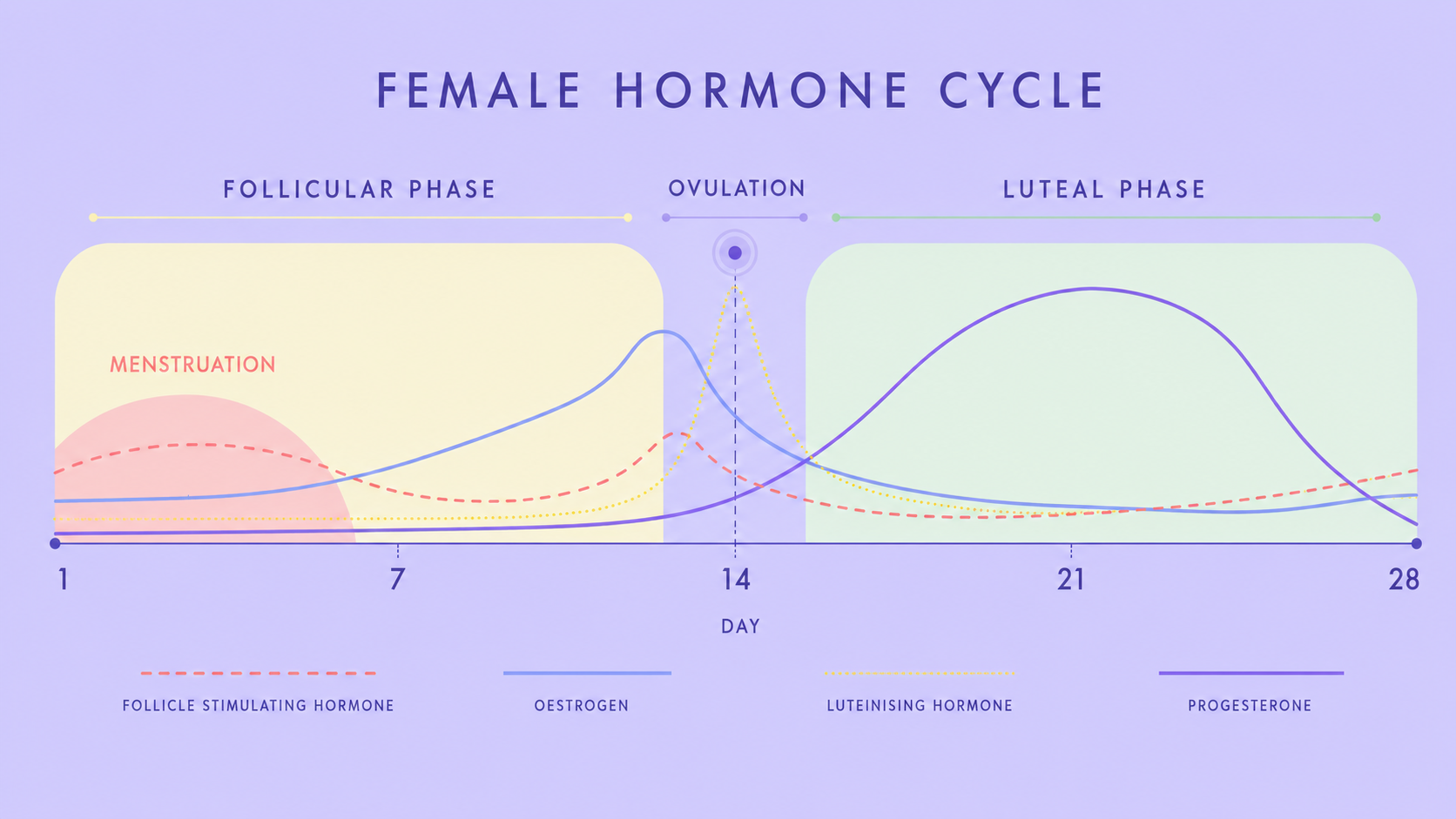
Illustration: created by keur, inspired by common menstrual cycle hormone diagrams.
Pregnancy, postpartum, and menopause
During pregnancy, breathing naturally changes to support the baby.
In their paper on respiratory physiology in pregnancy, LoMauro and Aliverti explain that minute ventilation can increase “by up to 48%” during the first trimester. In simple words: the mother breathes more air per minute, mainly because each breath becomes deeper (LoMauro & Aliverti, 2015).
This is not random. Pregnancy hormones, especially progesterone, make the breathing center in the brain more sensitive to CO₂. The mother’s body adapts so she can release not only her own CO₂, but also CO₂ coming from the baby through the placenta.
As the uterus grows, the diaphragm is also pushed upward, which can make deep belly breathing more difficult. This is why soft ribcage breathing, nasal breathing, and gentle extended exhales can be especially supportive.
During pregnancy, strong breath holds, intense fast breathing, and hypoxic practices should be avoided. Postpartum is another sensitive window. The body is healing, the nervous system is adapting, and emotional vulnerability can be high. Breathwork can be deeply supportive, but the focus should be on safety and grounding — not performance.
After menopause, changes in progesterone and estrogen may influence breathing, sleep, and respiratory regulation. Women also become more susceptible to sleep-disordered breathing, including sleep apnea. Slow, steady breathing, nasal breathing, and slightly longer exhales may support relaxation and nervous system regulation during this phase of life.
A randomized trial on paced respiration for menopausal symptoms found mixed results, which is important. Paced breathing should not be seen as a cure, but it can still be a simple, accessible way to support relaxation and self-regulation (Huang et al., 2015).
Four breathing practices we love for women
1. Alternate Nostril Breathing
A balancing practice that supports focus, calm, and nervous system regulation. It can be especially helpful in moments of emotional intensity, transition, overwhelm, or before sleep.
How to practice:
Close the right nostril and inhale through the left.
Close the left nostril and exhale through the right.
Inhale through the right.
Close the right and exhale through the left.
Breathing softly and without force.
Time: 3-5 minutes
Position: Seated or standing
2. Restorative 7–11 Breathing
A simple form of paced breathing that guides the breath into a slow, steady rhythm. With a slightly longer exhale, the nervous system can shift from activation toward regulation, making this practice especially supportive for stress, PMS tension, anxiety, sleep, and moments when the system feels overstimulated.
How to practice
Inhale gently through the nose for 7 counts.
Exhale slowly through the nose or mouth for 11 counts.
If 7–11 feels too long, use 4–6 or 5–8. The principle matters more than the numbers: the exhale is longer than the inhale.
Position: Lying down, seated, or standing
Time: 3-5 minutes
3. Humming Breath
Humming creates a gentle inner vibration that naturally supports nasal breathing and can have a deeply soothing effect on the nervous system.
Best for grounding, emotional regulation, quieting mental noise, and reconnecting with the body.
How to practice
Close your mouth and gently separate your teeth
Place the tongue against the roof of the mouth behind the upper teeth
Optional: cover the ear canals with your index fingers and close your eyes
Inhale slowly through the nose
Exhale through the nose while making a humming sound, similar to “om” or the buzzing of a bee
Feel the vibration in the face, throat, chest, or skull.
Position: Lying down, seated, or standing
Time: 3-5 minutes
4. The Perfect Breath / Coherent Breathing
In Breath: The New Science of a Lost Art, James Nestor describes what he calls “the perfect breath”: breathing in for about 5.5 seconds and breathing out for about 5.5 seconds — around 5.5 breaths per minute (Nestor, 2020).
This rhythm is often called coherent breathing: slow, steady, and simple. As the breath becomes coherent, the heart, brain, and nervous system begin to settle back into homeostasis.
How to practice
Inhale gently through the nose for around 5.5 seconds.
Exhale gently through the nose for around 5.5 seconds.
Continue in a smooth, steady rhythm
Position: Lying down, seated, or standing
Time: 5 minutes
The core principle: precision over intensity
Female bodies can respond deeply to breathwork. But the dose matters.
Some days, the body may enjoy intensity. Other days, especially in the luteal phase, during pregnancy, postpartum, or in times of high stress, the most powerful practice may be the gentlest one.
At keur, we believe breathwork becomes safer and more effective when physiology leads.
Not more pressure.
More listening.
Not harder breathing.
More intelligent breathing.
The female breath is dynamic, sensitive, and powerful and when met with care, it becomes a beautiful doorway back to rhythm, safety, and inner connection.
We explore the female breath more deeply in our 20h Breathwork Training and in our Breathwork Teacher Training.