
Every breath sends a message to your brain.
Most of the time, breathing runs on autopilot. But it is one of the few bodily functions you can alter on purpose, and when you change how you breathe, the brain listens and reflect. Its rhythms shift, numerous physiological responses kick into gear; changes in how you feel as one example. Many of these changes can be measured.
In this post, we look at what is known of some of the underlying mechanics, what the research does and doesn’t show, and three simple practices you can try today to change the state of the brain with your breath.
Why It Matters
Changing how we breathe alters what the information the brain receives from the body, and the brain responds by adjusting what it sends back. Slow, nasal breathing is one of the best-studied example: within minutes, heart rate variability rises, a sign of a more adaptable nervous system, and brainwaves shift toward a calm but alert state that people often describe as feeling at ease, grounded, centred. These short-term effects are well supported; the benefits of regular, longer-term practice continue to be studied, with many encouraging early results and an even long history of lessons that we can draw from traditions such as classical yoga.
How Your Breathing Speaks to Your Brain
Our brain and body are in constant communication. The autonomic nervous system runs two branches through nearly every organ. The sympathetic branch which mobilises energy: raising the heart rate, redirecting blood to muscle tissue, heightening alertness, and more. The parasympathetic branch which actively switches on rest and restorative processes: decreasing heart rate, supporting metabolic and digestive processes, enabling repair, consolidating memory, supporting immune function, and more.
The vagus nerve is the main parasympathetic line between brain and body, and about four in five of its fibres carry information from the body to the brain, not the other way around.¹ ² In other words, the vagus nerve spends most of its time ‘listening’ to the body rather than giving it instructions. The brain reading the body through incoming (afferent) inputs is called interoception. With slow, extended nasal exhalation as one of the few voluntary acts that reliably increases an upward flow of sensory information.
That is why changing the way we breathe can change the activity of the brain. It does so by changing the information the brain receives: the rhythm of the heart, the carbon dioxide in the blood, the pulse of air through the nose, the temperature of the skin, and so much more. A change in those inputs for a few minutes, or through a longer sustained practise and the outgoing signals to the body also change through shifts in the brain's electrical rhythm. How long a practice must be held for a given effect, and how much of it settles into a lasting baseline, is dependent on many factors though research is very much catching up.
What we know is that such shifts can be subtle or distinct, and both can meaningfully change how we feel and perceive ourselves and the world. When a change of perception is more apparent on a mental-emotional level, we describe it as a state shift.
Brain Waves & States

Artistic representation of brainwaves—not actual recorded brain activity.
Our brain is never still. Billions of neurons are constantly communicating, and their combined activity creates rhythms we call brainwaves. These rhythms change with our state: deeply asleep, relaxed, focused or highly alert. A brain state is characterised by a distinctive pattern of coordinated neural activity, often measured as electrical oscillations across neurons and brain areas. Large groups of neurons fire in loose synchrony, and the summed electrical activity rises and falls in waves that an electroencephalogram (EEG; a tool that measures electrical activity in brain matter close to the skull) can capture. Those waves are grouped by how many cycles they complete per second, and each band is loosely associated with a manner of being awake or asleep. The research is nuanced, and much of it focuses on memory, sleep and movement. For this article, what counts as evidence is a measurable shift in band power (how strongly one frequency range dominates the EEG signal) and phase-locking (how closely the brain’s rhythm keeps time with the breath or heartbeat) during or after a breathing session. The five main frequency ranges are summarised below:
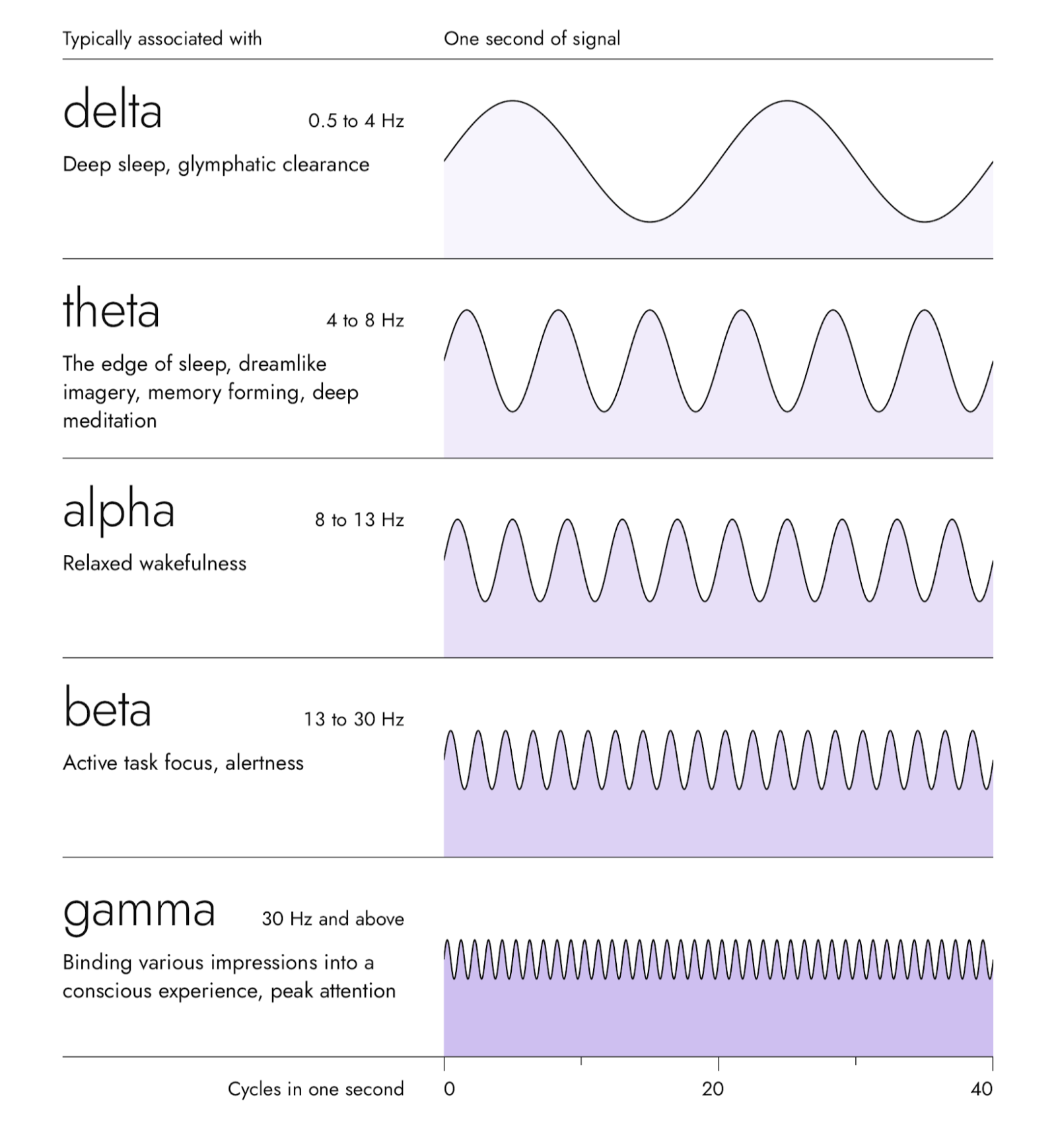
The Five Main Brainwave Frequency Ranges
How Breathing Changes Brain Activity
Every breath sends signals to the brain. Breathing does not change the brain state (EEG signal) through a single route. It shifts brain waves and creates new outgoing signals to the body. Research points to three main pathways:
Activity of the vagus nerve. How strong and how rhythmic the signal arriving from the heart, lungs, gut and other organs is.
Carbon dioxide level. How much CO₂ is in the blood, which sets the excitability of the cortex and the drive to breathe.
Presence of nose breathing. Whether a pulse of air is passing over the nose (olfactory epithelium) with each breath, which the olfactory bulb passes straight to the limbic system, the brain's emotion and memory network.
Change any one of these for a few minutes, and the brain's dominant rhythm can shift. It works the other way too: demanding mental tasks, rumination, or simply 'being in your head' can also affect the activity patterns of the brain and the downstream physiological effects we describe below. Where across sixty studies, worry and rumination reliably raise heart rate and cortisol while lowering HRV.³
Two Levers: Rate and Route
The rate of the breath and the route of the breath reach the brain by two different roads, and they work independently.
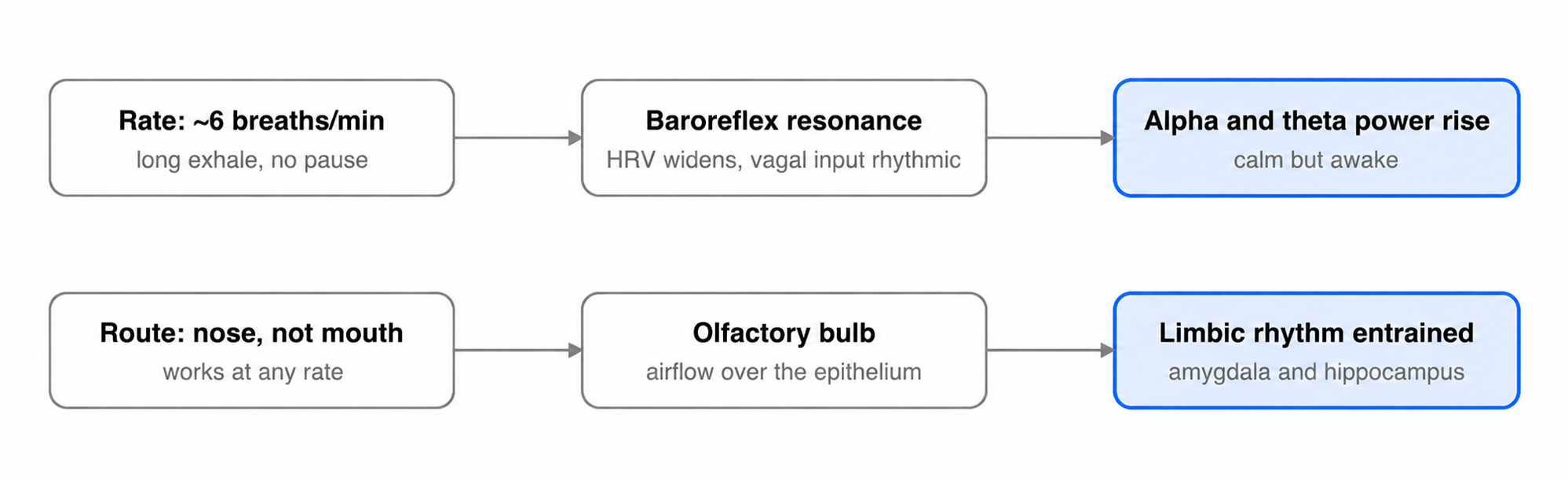
Two Levers Reach the Brain Through Two Separate Pathways
Rate.
At roughly six breaths per minute, breathing comes into resonance with the baroreflex, the loop that steadies blood pressure by adjusting heart rate beat to beat. At that pace the heart speeds up on every inhale and slows on every exhale in a wide, regular swing: the amplitude of those heart-rate oscillations grows to many times its resting size,⁴ HRV rises during the session and after repeated practice,⁵ the vagus nerve sends a stronger and more rhythmic signal up to the brainstem, and EEG recordings show a consistent rise in alpha and often theta power.⁶ Equal inhale and exhale works; a slightly longer exhale leans the balance further toward the parasympathetic.
Route.
Each breath in through the nose sets a rhythm in the brain's smell centre and, right beside it, the amygdala and hippocampus, the seats of emotion and memory. It is a direct line from the nose into the emotional brain, and it falls silent the moment breathing switches to the mouth. First shown with implanted electrodes in seven epilepsy patients,⁷ it has since been confirmed non-invasively at rest⁸ and for slow breathing specifically.⁹ The practical weight of this shows up in memory: pictures seen on a nasal inhale are recalled more easily than those seen on an exhale, and the advantage disappears when the same breath is taken through the mouth.⁷ Over a longer window it compounds: an hour of nose-only breathing after learning leaves memories better consolidated than an hour of mouth breathing.¹⁰ The nose is not just the healthier airway. It is the only one that keeps the memory circuits in rhythm.
Nasal breathing is not one technique among several. It can be seen as a condition that determines how well other techniques will work. For more information on this topic, including the relevance of the BOLT score, read further in Nose Breathing: The Foundation of Every Breathwork Practice.
Downstream: What Changes Besides Brainwaves
The EEG shift is the visible part of a chain that runs from breath to body and back, and further physiological effects follow when coherent nasal breathing is practised, especially over longer periods.
Baroreflex resonance: Breathing at the baroreflex's own frequency amplifies the blood-pressure/heart-rate loop; HRV increases.⁴ ⁵
Vagal afferent traffic: Heart, lungs and gut send a stronger, more rhythmic signal up to the brainstem. Its anatomy is well established; the specific slow-breathing mechanism is a published hypothesis.¹¹
Brain state: Calm, alert, flexible attention. People reliably report this; the proposed mechanism is that lower activity in the locus coeruleus, the brain's alertness hub, lets alpha dominate and makes attention easier to switch.¹² Sustained practice can shift the overall brain state.
Endocrine system and the body’s baseline: Resting heart rate drops, blood pressure eases, stress-hormone output falls in sustained practice. Replicated for heart rate, blood pressure and HRV; smaller and more variable for cortisol.⁶ ¹³
And this is just one example of a breath-to-brain cascade. Further examples exist for other brain-state frequencies, with applications in energy and focus, sleep, recovery, cognitive tasks and performance, something we review in more depth in the keur teacher training.
Breath and Altered States of Consciousness
An altered state is any state in which perception, sense of time or sense of self shifts measurably from ordinary waking, a term psychologist Charles Tart popularised in the 1960s. Meditation, flow, deep sleep and some breathwork practices are all known to incur such changes.
What makes a state altered at the physical level is not more brain activity, but a change in how brain regions connect and communicate compared to a regular state. In ordinary waking, the default mode network (the brain network that’s active when your mind references the self or sense of individuality) acts like a traffic conductor, deciding which regions talk to which. In altered states that control loosens, and communication spreads more evenly across the brain, in psychedelic states and in experienced meditators alike.¹⁷ ¹⁸ ¹⁹ Breathing is one way towards realising such states as well. Slow nasal breathing in experienced pranayama practitioners has been linked to non-ordinary states with measurable EEG changes.⁹ Faster, more intense techniques work largely through the carbon dioxide lever described above: lower CO₂ narrows blood vessels in the brain and shifts its rhythm.
The open question is what these states mean. The data show that a state has changed, not that it is “higher” or that it reaches beyond the nervous system.
How To Practice
Thom Van Der Meer, Neuroscience & Breathwork | keur Team
1. Coherence Breathing | Perfect Breath
Position: Seated or lying, spine long, mouth closed.
Practice:
Inhale through the nose for 4 to 6 seconds.
Exhale through the nose for 6 seconds. No pause between.
Keep it smooth, steady and continuous; the breath should feel quiet rather than deep.
Time: 5 to 20 minutes. If you track HRV, the waveform changes shape within the session.
Outcome: breath, heartbeat and EEG alpha move in phase; HRV rises and settles into a smooth, wave-like rhythm; alpha (and often theta) brainwaves increase.
People describe feeling centred: calm but awake. This is one of the few practices where what is measured and what people feel line up unusually well.
2. Nose Breathing
Position: Everywhere. At rest, at the desk, on walks; at night with tape once comfortable.
Practice: Mouth closed. Nothing to time. If you cannot keep the breath in the nose on a walk, slow down.
Time: All day. The more hours, the stronger every other technique becomes.
Outcome: nose breathing keeps the memory and emotion circuits in rhythm⁷ ⁸ and improves memory consolidation. ¹⁰ It also protects the sleep those circuits depend on (see the nose-breathing post above). Whether it improves emotional regulation directly is plausible yet untested.
People describe feeling steadier, especially after repeated and sustained practice (a week or more).
3. Cyclic Sighing: The Fast Downregulator
Position: Anywhere. Seated is easiest; it also works standing in a queue or before a meeting.
Practice:
Inhale through the nose until the lungs feel full.
Take a second, shorter sip of air on top, through the nose.
Exhale slowly through the mouth until the lungs are empty. Let the exhale run longer than both inhales together.
Time: 1 to 3 sighs when you need to come down quickly; 5 minutes daily for the trained effect.
Outcome: in a month-long randomised trial, five minutes a day of cyclic sighing improved mood and lowered resting breathing rate more than box breathing, cyclic hyperventilation or mindfulness meditation. ¹⁴ No EEG was recorded, so the brain state is inferred from the body, not measured directly. The mechanism fits the chain: the long exhale is the driver of vagal tone; the double inhale re-inflates the air sacs and helps offload CO₂.
Most people notice a drop in the shoulders within two or three breaths; a kind of reset, convenient when there isn't time for a longer practice.
What We Know So Far
Three caveats. First, most of the studies behind these statements measure a single session, not a month or a year. We know that ten minutes of practice changes the next hour; whether ten minutes a day resets your baseline is less proven. The longer-term data we have is encouraging but modest. A four-week trial found daily sighing improved mood more than mindfulness,¹⁴ and a meta-analysis of twelve trials using breathwork interventions found a small-to-medium reduction in self-reported stress.¹⁵ Second, the largest placebo-controlled trial of coherent breathing found no advantage over a matched placebo of breathing at twelve breaths per minute, however, firm conclusions could be premature.¹⁶ The result may reflect too little practice time or relevant lessons regarding the study design and methodology, but it is a useful check on bold claims. Third, the chain runs both ways: a calmer body sends calmer signals up, which steadies the breath further. That loop is the point of the practice, but it makes single-cause claims about any one link harder to isolate.
Start With One Breath
If there is one practice we recommend starting with, it is coherence breathing: about six breaths per minute, through the nose, no holds, for five to twenty minutes. It has the strongest evidence of everything above: a measurable effect on the heart, a well-studied mechanism, and remarkably consistent reports from the people who practise it. It is also a rhythm many breathwork traditions arrived at independently, from very different starting points.
Breathe through the nose. Lengthen the exhale. Let the brain listen.
References:
Berthoud HR, Neuhuber WL. "Functional and chemical anatomy of the afferent vagal system." Auton Neurosci. 2000;85(1-3):1–17.
Agostoni E, Chinnock JE, De Burgh Daly M, Murray JG. "Functional and histological studies of the vagus nerve and its branches to the heart, lungs and abdominal viscera in the cat." J Physiol. 1957;135(1):182–205.
Ottaviani C, Thayer JF, Verkuil B, Lonigro A, Medea B, Couyoumdjian A, Brosschot JF. "Physiological concomitants of perseverative cognition: A systematic review and meta-analysis." Psychol Bull. 2016;142(3):231–259. PMID 26689087.
Lehrer PM, Gevirtz R. "Heart rate variability biofeedback: how and why does it work?" Front Psychol. 2014;5:756.
Laborde S, Allen MS, Borges U, et al. "Effects of voluntary slow breathing on heart rate and heart rate variability: A systematic review and a meta-analysis." Neurosci Biobehav Rev. 2022;138:104711.
Zaccaro A, Piarulli A, Laurino M, et al. "How Breath-Control Can Change Your Life: A Systematic Review on Psycho-Physiological Correlates of Slow Breathing." Front Hum Neurosci. 2018;12:353.
Zelano C, Jiang H, Zhou G, et al. "Nasal Respiration Entrains Human Limbic Oscillations and Modulates Cognitive Function." J Neurosci. 2016;36(49):12448–12467. PMID 27927961.
Kluger DS, Gross J. "Respiration modulates oscillatory neural network activity at rest." PLoS Biol. 2021;19(11):e3001457.
Zaccaro A, Piarulli A, Melosini L, Menicucci D, Gemignani A. "Neural Correlates of Non-ordinary States of Consciousness in Pranayama Practitioners: The Role of Slow Nasal Breathing." Front Syst Neurosci. 2022;16:803904.
Arshamian A, Iravani B, Majid A, Lundström JN. "Respiration Modulates Olfactory Memory Consolidation in Humans." J Neurosci. 2018;38(48):10286–10294. PMID 30348674.
Noble DJ, Hochman S. "Hypothesis: Pulmonary Afferent Activity Patterns During Slow, Deep Breathing Contribute to the Neural Induction of Physiological Relaxation." Front Physiol. 2019;10:1176.
Melnychuk MC, Dockree PM, O'Connell RG, Murphy PR, Balsters JH, Robertson IH. "Coupling of respiration and attention via the locus coeruleus: Effects of meditation and pranayama." Psychophysiology. 2018;55(9):e13091.
Russo MA, Santarelli DM, O'Rourke D. "The physiological effects of slow breathing in the healthy human." Breathe. 2017;13(4):298–309.
Balban MY, Neri E, Kogon MM, et al. "Brief structured respiration practices enhance mood and reduce physiological arousal." Cell Rep Med. 2023;4(1):100895.
Fincham GW, Strauss C, Montero-Marin J, Cavanagh K. "Effect of breathwork on stress and mental health: a meta-analysis of randomised-controlled trials." Sci Rep. 2023;13:432.
Fincham GW, Strauss C, Cavanagh K. "Effect of coherent breathing on mental health and wellbeing: a randomised placebo-controlled trial." Sci Rep. 2023;13:22141.
Carhart-Harris RL. "The entropic brain – revisited." Neuropharmacology. 2018;142:167–178.
Carhart-Harris RL, Erritzoe D, Williams T, et al. "Neural correlates of the psychedelic state as determined by fMRI studies with psilocybin." Proc Natl Acad Sci USA. 2012;109(6):2138–2143.